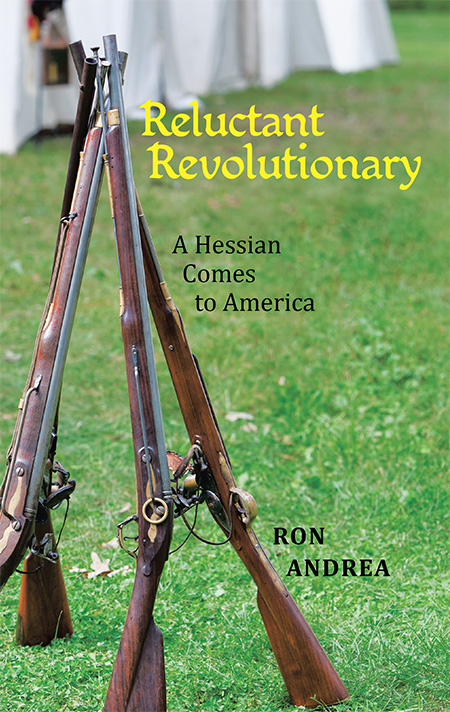
I was in a writing group for several years with Ron Andrea, author of The Reluctant Revolutionary, a coming-of-age story set in the American Revolution. Ron’s laser-eye for what a book needed and (alas) for what it didn’t was a treasure to all of us in the group. This has served readers of his book reviews on his blog A Matter of Fancy and in the Historical Novel Society Review. The last book of his we started was The Reluctant Revolutionary, inspired by his brother’s genealogical discovery that “we had a relative who fought in the American War of Independence — on the wrong side.” Ron’s book was then a work-in-progress, and the group disbanded before he and we reached its end. I was very happy to receive the news that he got a publisher for it and even happier to receive a printed copy from him.
Each stage of the hero’s journey (in ill-fitting and falling-apart shoes) had me rooting for him and immersed in his world, to a point where I didn’t want the book to end. (Okay, Ron, time to write a sequel!)
I asked Ron for some thoughts about the book and photos of his writing space. Here they are…
Part of the inspiration for writing The Reluctant Revolutionary was the reality that many people immigrated to the United States against their will. White indentured servants and many more Black enslaved people made up much of the labor force in the colonies — with very different terms of servitude and potential to get free. Jakob was forced to America by military draft; he chose to stay.
The big similarity between Jacob and me is that neither of us joined the military willingly. My career in the US Air Force started when I joined to avoid being drafted into the US Army during the Vietnam War. For both Jakob and I, military service changed us profoundly.
Literacy among the masses of men shipped to the colonies as soldiers was not a given. However, Jacob’s family had lived in Niederdünzebach, Werra-Meissner-Kreis, Hessen, for 250 years and held local offices like postmaster or assessor, so making him literate did not seem a stretch. I tried to portray him as young and naive, but not stupid. Learning to speak and read English would have been a natural thing to do, especially as the war dragged on. I had Jakob show a little initiative because it propelled the story. His fictional friend Fredrich Hansreif creates an intellectual foil.
I portray Jakob as a Protestant Christian; he could have been either a Lutheran or a Calvinist, so I kept that vague. I try not to make him into a twentieth-century-style evangelical, though men like George Whitefield and Jonathan Edwards indicate that such existed.
Since I studied colonial history at Southwestern College, Winfield, Kansas, I was inspired to create a back story for Jakob, with a wealth of information about his unit and its activities. I am not a reenactor but conversed with them for additional background. (Too bad Jakob never entered Virginia during the period of the story. I could have dropped a lot of names!)
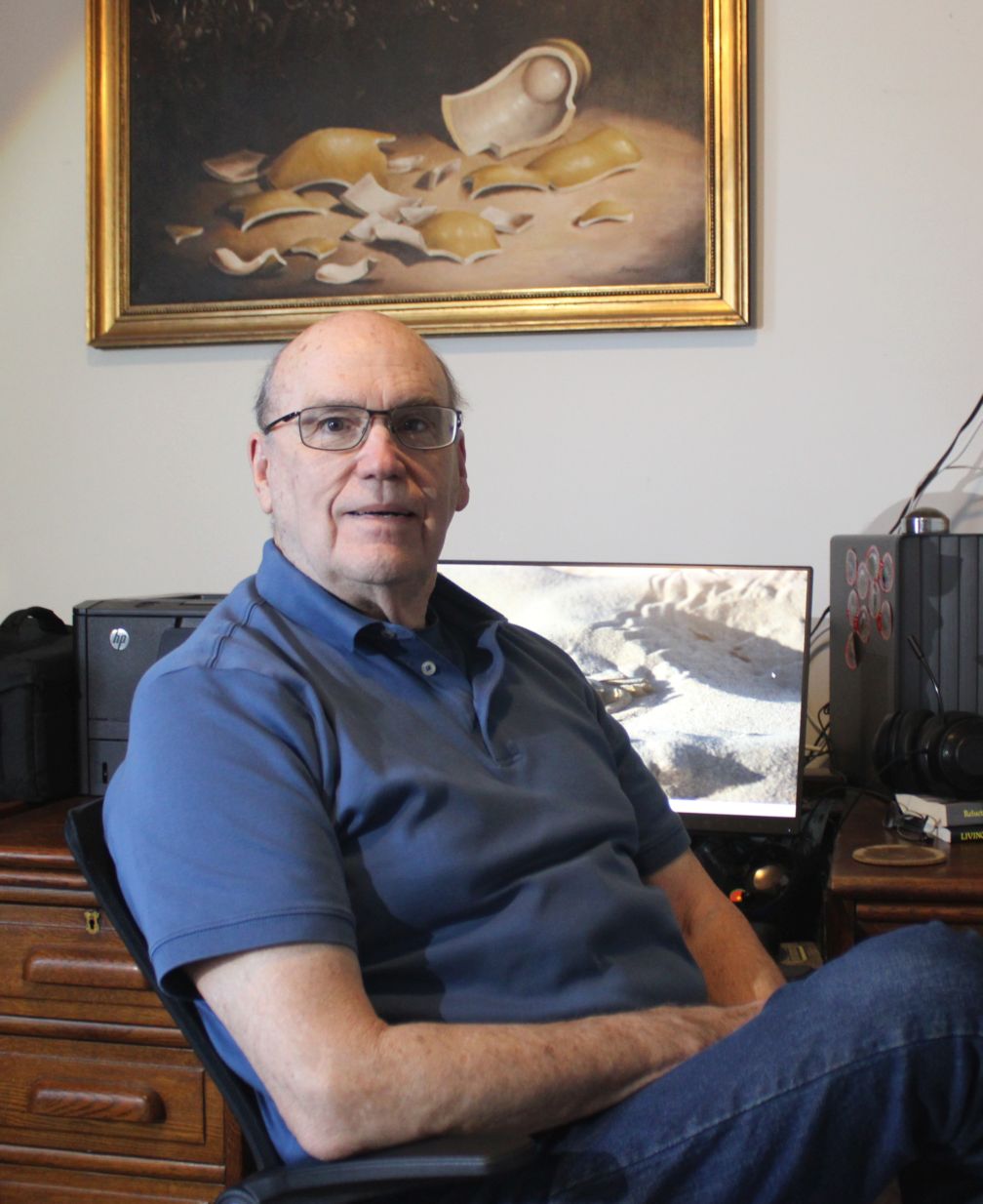
Q: Tell a bit about your painting. Does it enhance your writing? Compete with it? Or…?
A: I have painted watercolors exclusively for the last twenty plus years. I am a very visual person. Painting helps me consider what I’m seeing and how to express it. The capturing and expressing in words is enhanced, I hope, by my painting.
Q: Picture above the desk means…?
A: The oil painting was the final exam piece for a college art course. It was inspired by a Chinese poem “Garden of Golden Valley,” about a girl who throws herself from a balcony at sunset. I bought a Chinese ginger jar and broke it to symbolize the girl.
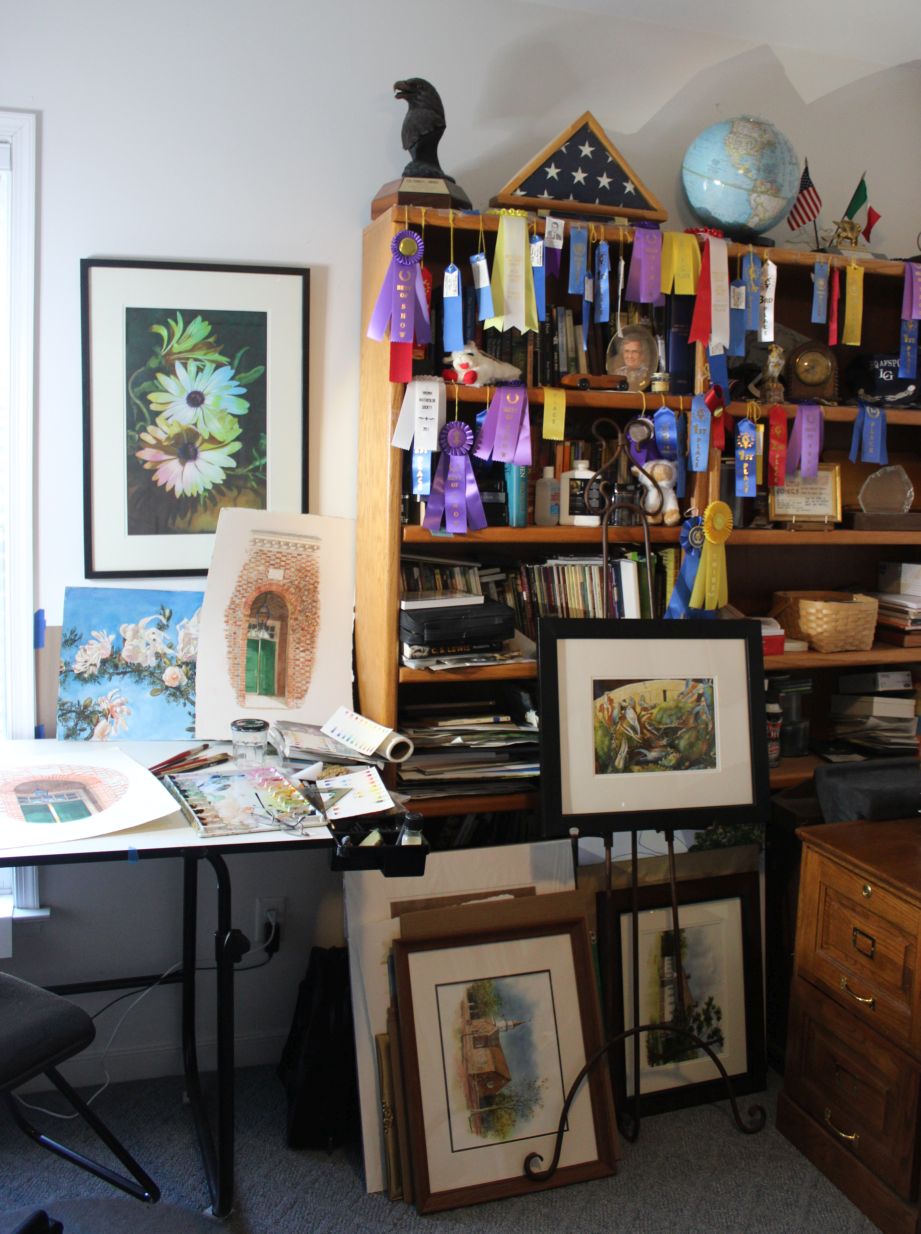
Q: What are the ribbons for?
A: The ribbons are for my art from various shows in Colorado and Virginia over the last twenty years.
Q: The flags?
A: The twinned flags are American and Italian. I was a logistics group commander from 1992 to 1995 at Aviano Air Base in northern Italy, an hour from Venice. Half of my work force were Italian civilians. We did a lot of mutual admiration team building between the nations. The winged lion was the symbol of that province.
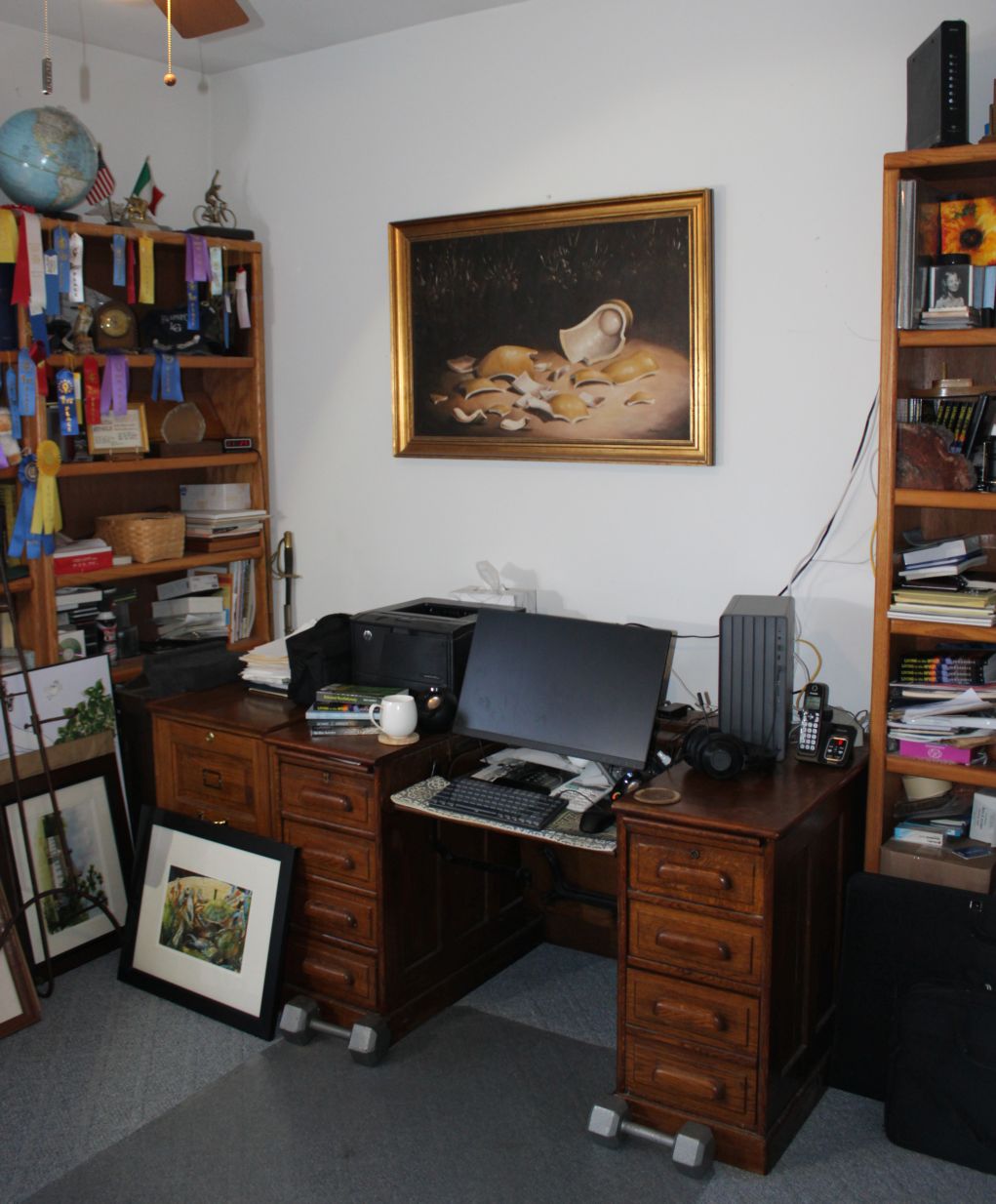
Q: What’s the story of the sword (to left of the desk)?
A: The sword is a US cavalry sabre made in Massachusetts in 1865. It was found in the attic of an older house in Leavenworth, Kansas. I bought it from the family who bought the house and found it.
Q: What’s with the weights on the floor?
A: The weights remind me to exercise (which I just paused to do).